
First project workshop - 30 July 2026
Celebrating our project start in Ouro Preto and Mariana: from ancestral river rights to rights-of-nature frameworks
After long months of preparation, 1 July finally marked the official start of our ESRC-FAPESP research project, which analyses the role of Rights-of-Nature legal frameworks in protecting rivers across Brazil. As our project start coincided with the Brazilian Rights of Nature Movement’s third national Forum (31 July–2 August), organised by our partner Vanessa Hasson (MAPAS) in the historic towns of Ouro Preto and Mariana, we decided to hold our first team workshop (30 July) in the same places to strengthen our ties with the movement.
Ouro Preto and Mariana are two neighbouring towns nestled in the dramatic mountain ranges of the interior of the state of Minas Gerais, approximately 100 kilometres from the state’s capital, Belo Horizonte. In the 18th century, both towns became famous for their unrivalled gold production, driving Brazil’s gold rush and transforming Minas Gerais into the colony’s centre for gold mining. For most of that century, Ouro Preto alone produced more gold for the Portuguese Empire than all other gold mines in the Americas did between the beginning of colonisation in the late 15th century and the mid-19th century. Today, Ouro Preto's historic architecture offers a snapshot of its once golden era, when it was one of the most important cities of Brazil's South-Central (Centro-Sul) region. Its many Baroque churches, with their exuberant ceiling paintings, intricate gold and wood carvings and meticulous stonework, still bear testimony to an era of extraordinary wealth and riches. And in 1980, Ouro Preto was officially recognised as a UNESCO World Heritage Site. At the same time, the splendour of Ouro Preto and its neighbouring towns is a reminder of some of Brazil’s darkest chapters. This golden era would hardly have been possible without the dispossession of indigenous territories, the destruction of vital ecosystems, and the forced labour of thousands of African slaves who had to toil away in the gold mines under appalling conditions and who built those mansions and churches that are now admired by tourists from all over the world.

Ouro Preto (photo by Markus Fraundorfer)
While the region’s gold rush has receded in memory, mining continues to dominate the region, with hundreds of tailings dams scattered across the state of Minas Gerais. In 2015, Mariana left a tragic mark on Brazil’s more recent history when a nearby tailings dam collapsed, flooding one of the town’s districts and devastating the Doce River basin with more than 40 million cubic meters of iron ore waste. The images of a dead Doce River, tainted in dirty shades of orange and brown, with highly toxic waste flowing into the Atlantic Ocean and laying waste to everything in its way, made international headlines at the time. The dam was operated by Samarco, one of Brazil’s largest mining companies. Even over ten years later, hundreds of thousands of affected people are still suffering from the consequences of this catastrophe and are seeking compensation from Samarco for its environmental crimes.
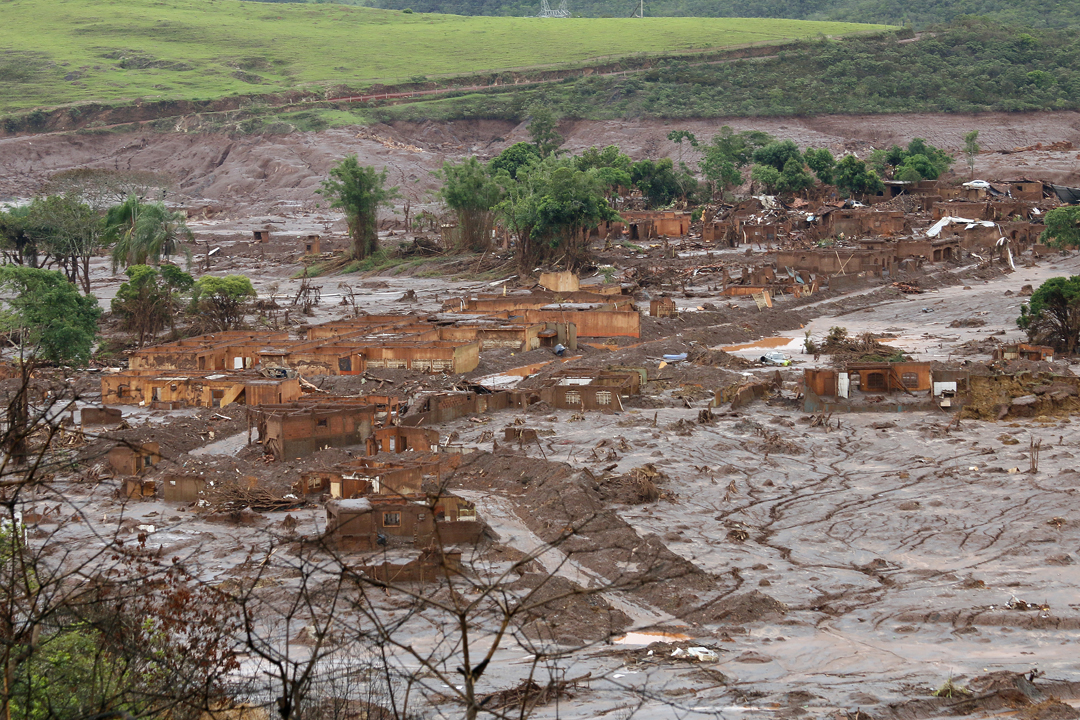
The village of Bento Rodrigues, Mariana, after the disaster. (Senado Federal. CC BY 2.0. Available at: https://en.wikipedia.org/wiki/Mariana_dam_disaster#/media/File:Bento_Rodrigues,_Mariana,_Minas_Gerais_(22828956680).jpg)
There could not have been a more apt place to organise a Rights of Nature Forum about the future of rivers than Mariana, which brought together 470 members of Brazil’s rights of nature movement, including representatives of Brazilian civil society organisations, academia, indigenous communities, Quilombo communities, and riverine communities. This third edition of the Rights of Nature Forum focused on strengthening networks in the fight against climate change and contributing to the development of the Brazilian government’s Climate Plan (Plano Clima). The three days were marked by legal debates, community practices, traditional communities’ cultural expressions, artistic river mapping activities, and strategic discussions about public policies.
Our workshop took place in Mariana on 30 July, the day before the Forum began, at the School of Social Sciences and Humanities of the Federal University of Ouro Preto. It was the first opportunity for all team members and project partners to meet in person and discuss in more depth the four specific rivers (Portuguese: rios) and associated communities that we will focus on during the project: the Rio Laje (or Komi Memem) in Rondônia, the Rio Vermelho in Goiás, the Rio Mosquito in Minas Gerais, and the waves at the mouth of the Rio Doce in Linhares, Espírito Santo. As a bonus, our workshop was attended by several indigenous leaders, Brazilian students, and other members of the Rights of Nature movement, which provided us with the opportunity to link our project goals more closely to the communities’ needs and requirements.

Our research team in Mariana (photo by Adriana Ressiore)
The next day, the Forum was officially inaugurated by indigenous leaders at Ouro Preto’s Parque das Andorinhas, the source of the Rio das Velhas-Uaimií, which, 800 kilometres downstream, flows into the mighty Rio São Francisco, the longest river that runs entirely on Brazilian territory. Guided by indigenous leaders’ ancestral practices, we celebrated the importance of the land and water sources to life, nature, and identity.

Sunset at the Parque das Andorinhas (photo by Markus Fraundorfer)

Representatives of indigenous and traditional communities inaugurating the Forum (photo by Markus Fraundorfer)
On the following day, Forum-specific workshops discussed a string of themes underpinning rights-of-nature approaches.
One workshop on childhood and adolescence discussed the rights of nature in the context of childhood memories linked to water, rivers, and nature, and what happens to new generations who can no longer develop a relationship with clean rivers through playing or bathing. In this context, high childhood mortality among indigenous and other traditional communities due to the contamination of rivers from mining was a major point of discussion. Questions emerged about the difficulty that many communities face in developing a close and healthy bond with the rivers on their territories in the face of the overlapping socio-economic and environmental pressures (deforestation, mining, poverty, inequality, stigma, and so forth) that confront today’s generation with a severe loss of identity. The challenge remains how to recognise territory as a space for memory, relationship, and identity.
Another workshop focused on the relationship between ancestral communitarian law and rights of nature. Representatives of communities living along the Rio Mosquito in the north of Minas Gerais, the Rio Camaquã in Rio Grande do Sul, the local Uamií (Rio das Velhas), and the Rio das Mortes in Matto Grosso shared their experiences about how ancestral communitarian law informs community struggles advocating for rights of nature frameworks to protect communities and their relationship with rivers. Because indigenous and other traditional communities’ practices that value the ancestral relationship between communities and rivers are much older than any formal written legal norms and laws, ancestral communitarian law is the most adequate source to inspire today’s rights of nature frameworks and fill them with meaning. After all, in communities’ ancestral communitarian law, rivers have always enjoyed rights. However, the acceleration of river pollution and environmental degradation increasingly disrupt this ancestral relationship, hence the urgency of rights-of-nature frameworks to rebuild relationships and institutionalise them through river guardianship committees.

Participants of the workshop on ancestral communitarian law (photo by Markus Fraundorfer)
A third workshop reflected on the role of community practices for rights of nature in the context of agroecological practices, a just energy transition, river and ocean protection, reforestation, and other environmental conservation efforts. Here, again, a consensus emerged that the meaning of rights of nature ultimately emerges from indigenous cosmovisions and traditional community practices. A fourth workshop stimulated discussions about the potential of rights of nature for the development of novel public policies in Brazil.
The challenge now is to reflect on how to transform these manifold discussions into concrete actions, institutionalising rights-of-nature frameworks in ways that strengthen communities’ ancestral relationships with rivers, fortify communities’ struggle for their territory and identity and, ultimately, help shield Brazil’s rivers from further environmental degradation and contamination. And this is where we hope our project can add value.
The stakes are high. This summer in Europe has once again shown how urgent it is to pursue innovative international research on rivers and the environment more broadly. European countries suffered from a record-high number of heat waves and struggled with unprecedented droughts. As a case in point, the Rhine and the Danube, two of the continent’s most emblematic rivers, were reduced to a fraction of their original size and volume, laying bare their dry and stony riverbeds and making many passages impossible, with grave knock-on effects for Europe’s economy and, yes, people’s deep cultural relationships with these rivers. In Brazil, record-breaking droughts have also become the new normal, with the country’s mighty rivers falling to such low levels during the dry season that the consequences are felt not only across Brazil but worldwide, disrupting globalised food production and further exacerbating the global climate crisis.
Over the next four years, our team will analyse how and to what extent Rights-of-Nature approaches can offer solutions to this global river crisis. At the same time, we are acutely aware of the challenges of advocating for new legal and political frameworks that defy deeply entrenched power imbalances, particularly in Brazil. Nowhere was this dilemma more evident than during the Forum activities in Mariana. Ironically, the event in Mariana coincided with an exhibition of life-size animal sculptures at the town’s main square, Praça Gomes Freire. Known as a “Smart Zoo” due to the animal sculptures’ ability to move their necks and utter sounds, strangely, most of the exhibition’s animals had no relationship with Brazil and its ecosystems whatsoever. There were zebras, a giraffe, a lion, a camel, two kangaroos, a gorilla, two mandrills, a family of African elephants, a group of penguins, and a herd of rhinos. Still, to the installation’s credit, there was the obligatory toucan, a lonely jaguar and some crocodiles swimming in artificial waters. Above these artificial animals, a large white balloon was silently hovering, with the name of the exhibition’s sponsor printed in large blue letters. The sponsor was none other than Samarco, a large employer and funder of many cultural events in the region – the very same company that was responsible for the collapse of its tailings dam in 2015, which flooded one of Mariana’s sub-districts and contaminated the entire Doce River, the largest environmental catastrophe in Brazil’s history.
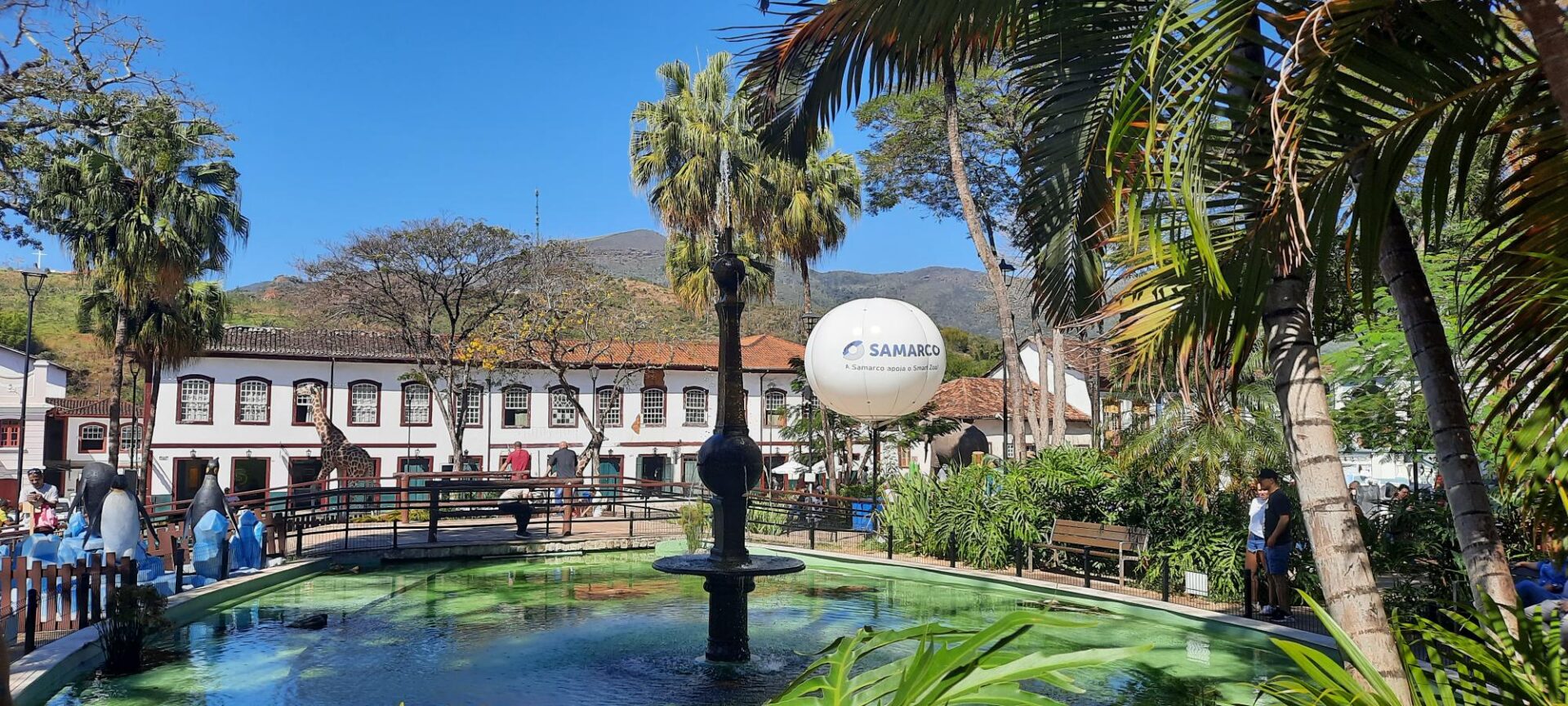
Praça Gomes Freire, Mariana (photo by Markus Fraundorfer)
The last day of the Forum was a beautiful Sunday. An impeccable blue sky, the faint smell of slow-roasted meat hanging in the air, and the town’s many families flocking to the picturesque restaurants, cafés, and snackbars around Mariana’s main square to enjoy their day out, listen to local folkloric bands and admire the Smart Zoo’s exotic animals. Amid this peaceful and serene scenery, it struck me that many locals adored Samarco’s artificial animals but seemed largely oblivious of the Rights of Nature Forum that was coming to a close in the town’s century-old municipal theatre just a few meters off the square.
References:
- Alessandra Sousa, Ana Luiza Moreira, Mariana Nunes, and Tallison Gomes (2026), 3º Fórum Brasileiro dos Direitos da Natureza. Sumário Executivo, Articulação Brasileira Pelos Direitos da Natureza, Harmony with Nature Study Group, and FACAMP.
- Dom Philipps (2016), “Samarco dam collapse: one year on from Brazil's worst environmental disaster”, The Guardian, 15 October. Available at https://www.theguardian.com/sustainable-business/2016/oct/15/samarco-dam-collapse-brazil-worst-environmental-disaster-bhp-billiton-vale-mining (Accessed 12 August 2026).
- Pogust Goodhead (2026), “Mariana Dam Disaster”. Available at https://pogustgoodhead.com/cases/mariana-dam-disaster/ (Accessed 12 Aufust 2026).
- Prefeitura de Ouro Preto (2026), “Ouro Preto - Patrimônio Cultural Mundial”. Available at https://www.ouropreto.mg.gov.br/turismo/acidade (Accessed 12 August 2026).
For any questions, feel free to get in touch with the project’s Principal Investigator, Dr Markus Fraundorfer ([email protected]).