
Lough Neagh

The CLEAR-Neagh project (Catchment-Level Environmental AMR & eDNA Reconnaissance for Lough Neagh) is jointly funded by NERC and DAERA.
Project lead is Dr Susheel Bhanu Busi, Head of Molecular Ecology at UK Centre for Ecology and Hydrology (UKCEH) working with the UKCEH Molecular Ecology Group and the Aquatic Ecology group, also Biota Trace and the Lough Neagh Partnership.
CLEAR-Neagh – March 2026 until November 2027
This £920,000 project will generate clear scientific evidence to help restore Lough Neagh in the centre of Northern Ireland. Findings will be used to create a long-term plan to improve the environmental status of the badly degraded lake.
The lake is one of the most important freshwater resources in the United Kingdom. It supplies drinking water to hundreds of thousands of people, supports agriculture and fisheries and provides habitat for diverse wildlife.
It is nearly 400 km² in area and provides around 40 per cent of Northern Ireland’s drinking water. Its catchment extends into Counties Monaghan and Cavan within the Republic of Irelands.
Why is the research project vital?
The lake and its rivers are under increasing risk of becoming polluted by excess nutrients, run-off from farms, discharges from industrial sources, wastewater treatment works and a new threat of the spread of antimicrobial resistance (AMR) in the environment that can pose risks to ecosystems, livestock and human health.
In 2023, the lake was covered in a severe bloom of blue-green algae which caused the deaths of pets and wildlife and the closure of recreational and fishing areas.
This highlighted an urgent need for better tools to identify the sources and movement of pollution across the catchment.
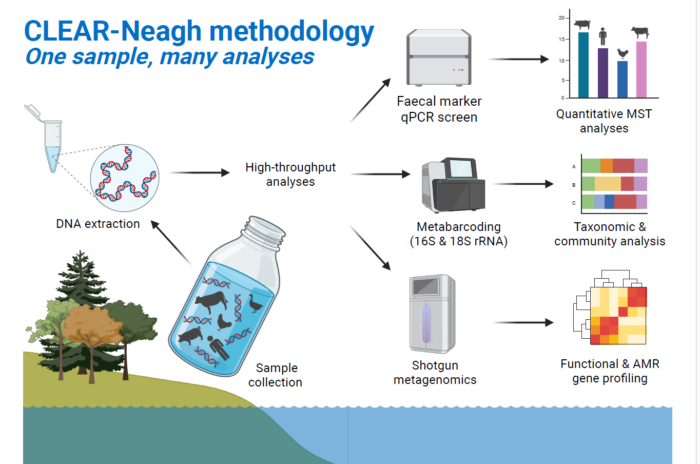
What does the project involve?
- Specialised tools and methods, including advanced microbial source tracking and environmental DNA (eDNA) techniques, will be used to trace pollution across the Lough Neagh system including tributaries, inlets and the shoreline.
- Analysing DNA from water collected across the lake, its tributaries and outflows, to discover whether the source of the contamination is human, agricultural or wildlife
- The Lough Neagh Partnership will support field surveys and data collection, alongside UKCEH and project partners.
- State-of-the-art technology, including automated high-frequency sampling and autonomous unmanned survey vessels, will be used to collect samples in areas that are otherwise difficult or unsafe to access.
- AMR genes will be monitored to provide early warning of risks to ecosystems, livestock and public health.
The outcome
Data will be integrated with catchment models and hydrological information to produce high-resolution maps of pollution sources, seasonal patterns and key risk pathways.
The CLEAR-Neagh project will produce practical tools and clear evidence. These will be shared with the Lough Neagh Partnership and other stakeholders to support the restoration and long-term care of the lake.

Photographs by Peter Harper, Lough Neagh Partnership